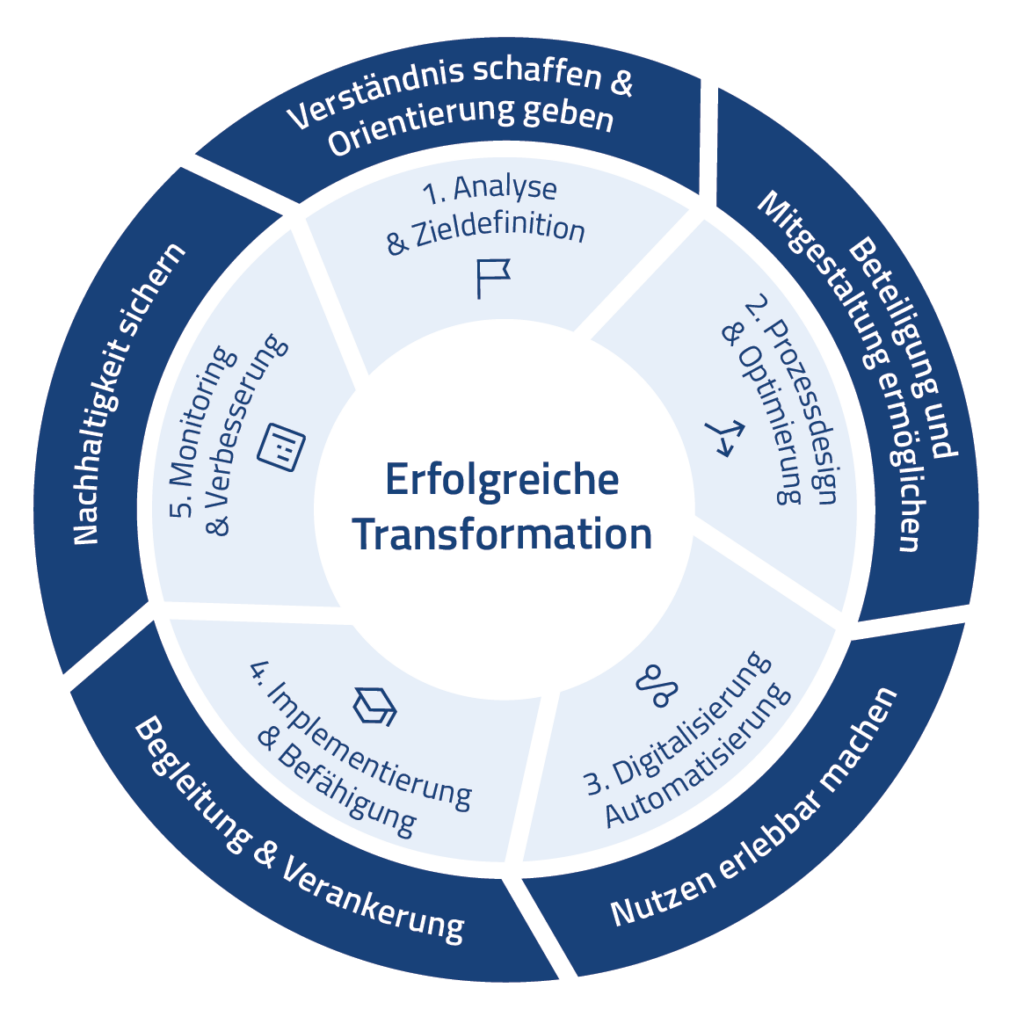
Successful digital transformation involves more than just implementing new software: it requires a clear analysis, process optimization, and the sustainable implementation of automation. In practice, companies often lack the internal resources, experience, or methodological expertise. As a result, many digital transformation projects fail due to unclear objectives, a lack of integration, or inadequate change management.
We help companies design structured transformation initiatives, set the right priorities, and successfully, sustainably, and scalably realize automation potential in core operational processes such as production, logistics, procurement, quality management, and supply chain management.
Holistic Transformation with Consistently Integrated Change Management
Successful transformation doesn’t happen at the end of a project—it starts right from the beginning. That’s why we support every phase of our process with targeted measures that ensure changes are understood, accepted, and actively supported. You can count on it:
Early delivery of measurable added value and quick wins
End-to-End Process Focus Across Departments and Systems
Consistent automation of low-value-added tasks
Higher Adoption Rate of New Solutions
Ensuring the Planned Return on Investment
Long-term value growth rather than one-time optimization gains
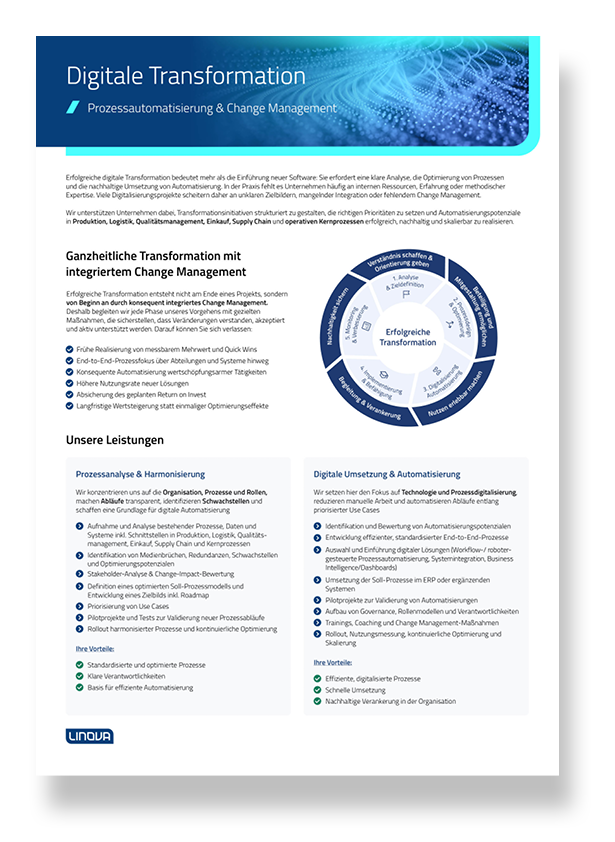
Digital Transformation – All information at a glance.
We help companies design structured transformation initiatives, set the right priorities, and successfully implement automation opportunities in a sustainable and scalable manner. Learn more in our service fact sheet:
We focus on the organization, processes, and roles; make workflows transparent; identify weaknesses; and lay the groundwork for digital automation.
Mapping and analysis of existing processes, data, and systems—including interfaces—in production, logistics, quality management, procurement, the supply chain, and core processes
Identification of data disconnects, redundancies, vulnerabilities, and opportunities for optimization
Stakeholder analysis & change impact assessment
Definition of an optimized target process model and development of a target state, including a roadmap
Prioritization of use cases
Pilot projects and tests to validate new process flows
Rollout of harmonized processes and continuous optimization
Your benefits:
Standardized and optimized processes
Clear responsibilities
Foundation for efficient automation
Digital Implementation &
Automation
Here, we focus on technology and process digitization, reduce manual work, and automate processes based on prioritized use cases
Identification and evaluation of automation potential
Development of efficient, standardized end-to-end processes
Selection and implementation of digital solutions (workflow/robot-driven process automation, system integration, business intelligence/dashboards)
Implementation of target processes in ERP or complementary systems
Pilot projects to validate automation
Establishment of governance, role models, and responsibilities
Training, coaching, and change management initiatives
Rollout, usage measurement, continuous optimization, and scaling
Your benefits:
Efficient, digitized processes
Rapid implementation
Sustainable integration into the organization
Our Methods and Standards
Analysis & Goal Setting
Business Process Modeling (BPMN)
Process Analysis & Visualization (SIPOC)
Stakeholder Analysis
Business Case Modeling
Process Design & Optimization
Lean Management
Event Storming
Design Thinking
Customer Journey Mapping
Activity-Based Costing
Digitalization & Automation
Workflow Design
System Integration
Data Governance
API-Based Architectures
Generative & Agent-Based AI
For companies that have already launched projects but realize they can’t move forward on their own, we offer targeted support: We help realign existing projects, quickly implement prioritized use cases, and successfully embed digital transformation within the organization.
The Most Common Challenges in Digital Transformation Projects
Lack of time
Skill gaps
Integration of legacy systems
Adoption and Implementation
Complexity of Digital Processes
Security Criteria
A Strategy for Digital Transformation
One in two companies fails to successfully implement digital transformation projects. This is often due to a shortage of time and skilled workers, high workloads, and outdated IT systems. Complex integration and inadequate planning, a lack of acceptance, and strict requirements for data protection and collaboration further complicate implementation. The result is delayed or incomplete projects, rising costs, and a lack of added value. At the same time, inefficiencies, security risks, and communication problems lead to economic disadvantages and weaken competitiveness.
Laden Sie sich jetzt kostenfrei das E-Paper Potenzialanalyse: Daten & KI herunter und machen Sie den 5-Minuten-Check:
✔️ 10 Fragen zur Einordnung des digitalen Reifegrads ✔️ individuelle Erfolgschancen und Ableitungen für Ihr Unternehmen ✔️ konkrete, priorisierte Maßnahmen je Reifegradstufe