Project Management
Expertise for your projects — from idea to successful completion.
Project Management Maturity Levels — where does your organization stand?
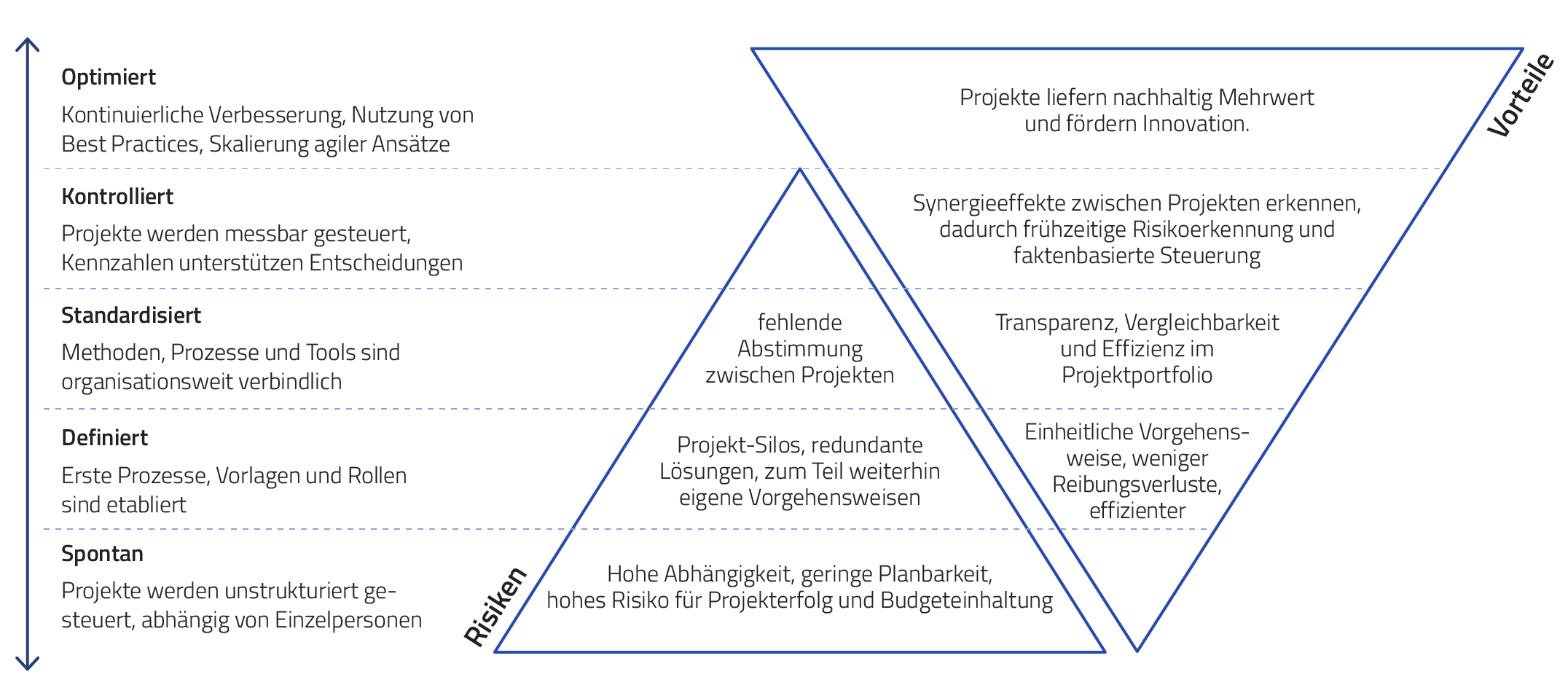
Project Management Maturity Levels — where does your organization stand?
Spontaneous
Projects are managed in an unstructured manner, dependent on individuals.
Risk: high dependency, low predictability, high risk to project success and budget adherence.
Defined
Initial processes, templates, and roles have been established.
Advantage: Uniform approach, fewer friction losses, more efficient.
Risk: Project silos, redundant solutions, and in parts continued use of individual approaches.
Standardized
Methods, processes, and tools are mandatory organization-wide.
Advantage: Transparency, comparability, and efficiency in the project portfolio.
Risk: Lack of coordination between projects.
Controlled
Projects are managed in a measurable way; metrics support decision-making.
Advantage: Identify synergies across projects, enabling early risk detection and fact-based steering.
Optimized
Continuous improvement, adoption of best practices, and scaling of agile approaches.
Advantage: Projects deliver sustainable added value and promote innovation.
Project Management Maturity Levels — where does your organization stand?
Spontaneous
Projects are managed in an unstructured manner, dependent on individuals.
Risk: high dependency, low predictability, high risk to project success and budget adherence.
Defined
Initial processes, templates, and roles have been established.
Advantage: Uniform approach, fewer friction losses, more efficient.
Risk: Project silos, redundant solutions, and in parts continued use of individual approaches.
Standardisiert
Methoden, Prozesse und Tools sind organisationsweit verbindlich
Vorteil: Transparenz, Vergleichbarkeit und Effizienz im Projektportfolio
Risiko: fehlende Abstimmung zwischen Projekten
Controlled
Projects are managed in a measurable way; metrics support decision-making.
Advantage: Identify synergies across projects, enabling early risk detection and fact-based steering.
Optimized
Continuous improvement, adoption of best practices, and scaling of agile approaches.
Advantage: Projects deliver sustainable added value and promote innovation.
By introducing standardized structures, you encourage quality, comparability, and scalability across the entire project portfolio.

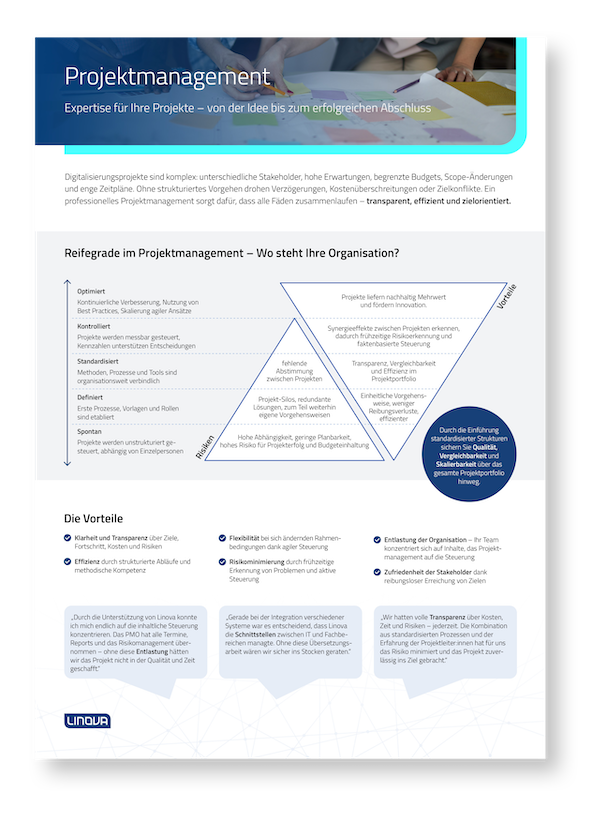
We support you with project management—get a complete overview of all services at a glance!
We support you with expert consulting, hands-on project support, and end-to-end project leadership. Learn more about our services in the relevant fact sheet:
Project Phases & Success Factors at a glance
1. Initialization
Keep a clear focus on goal definition and role allocation from the outset
A project is primed for success when objectives, benefits, and responsibilities are clearly described. A transparent project charter and early involvement of relevant stakeholders starts your journey with a common understanding of goals and acceptance criteria.
2. Planning
Create realistic plans, robust structures, and risk awareness
Thoughtful scheduling and resource planning, as well as the identification of potential risks, lay the foundation for a controllable project. Standardized processes, methods, and tools increase comparability and reduce friction losses.
3. Controlling & Execution
Ensuring continuous transparency, agility, and flexibility
Goals are attained with ongoing progress checks, regular status reports, and a structured approach. Agile elements such as short feedback cycles and iterative approaches enable rapid responses to new requirements.
4. Closure & Handover
Sustainably successful thanks to clean documentation and knowledge retention
A structured project close-out with a final report, lessons learned, and complete handover ensures that the project results are sustainably usable and that future initiatives benefit from the experience.
Our Expertise

Consulting
Applying our domain expertise, we identify the right delivery methodology for your projects. Our consulting services span from strategic method selection to hands-on support in day-to-day project work.
- Selection of suitable project management methods (traditional/waterfall, agile, or hybrid)
- Implementation of analytical methods such as SWOT, risk analysis, stakeholder analysis, and business case modeling
- Use of modern facilitation and workshop formats (e.g., Design Thinking, retrospectives, prioritization techniques)
- Coaching for internal project managers and teams
- Strategic development of project management standards and processes

Project Support
We provide flexible support exactly where you need relief. Depending on your needs, This may come as individual work packages within specific projects or centralized oversight in the Project Management Office.
- Resource management, scheduling, reporting, and project control
- Organization and facilitation of workshops, preparation of status reports, maintenance of project documentation
- Stakeholder management and communication planning
- Consistent project control via the standardization of processes, templates, and tools
- Establishment of portfolio management structures and cross-project governance

Project Lead
When complexity rises, internal resources are scarce, or a neutral party between stakeholders is missing, we can assume interim leadership of your project. On you request, we can ensure quality, accelerate processes, and steer your project success using proven standards, and best practices.
- Full responsibility for planning, steering, and goal attainment
- Leadership and development of cross-functional teams; coordination of all stakeholders
- Ensuring budget compliance, timelines, and quality
- Representing the project to management and stakeholders
Qualifications & Practical Experience
Contact us now
Contact us for a free initial consultation

Sandra von König Senior Sales Manager
I look forward talking to you!